I’ve gone on and on about why I’m not racing before, but this feels different, so please give me two minutes of your time.
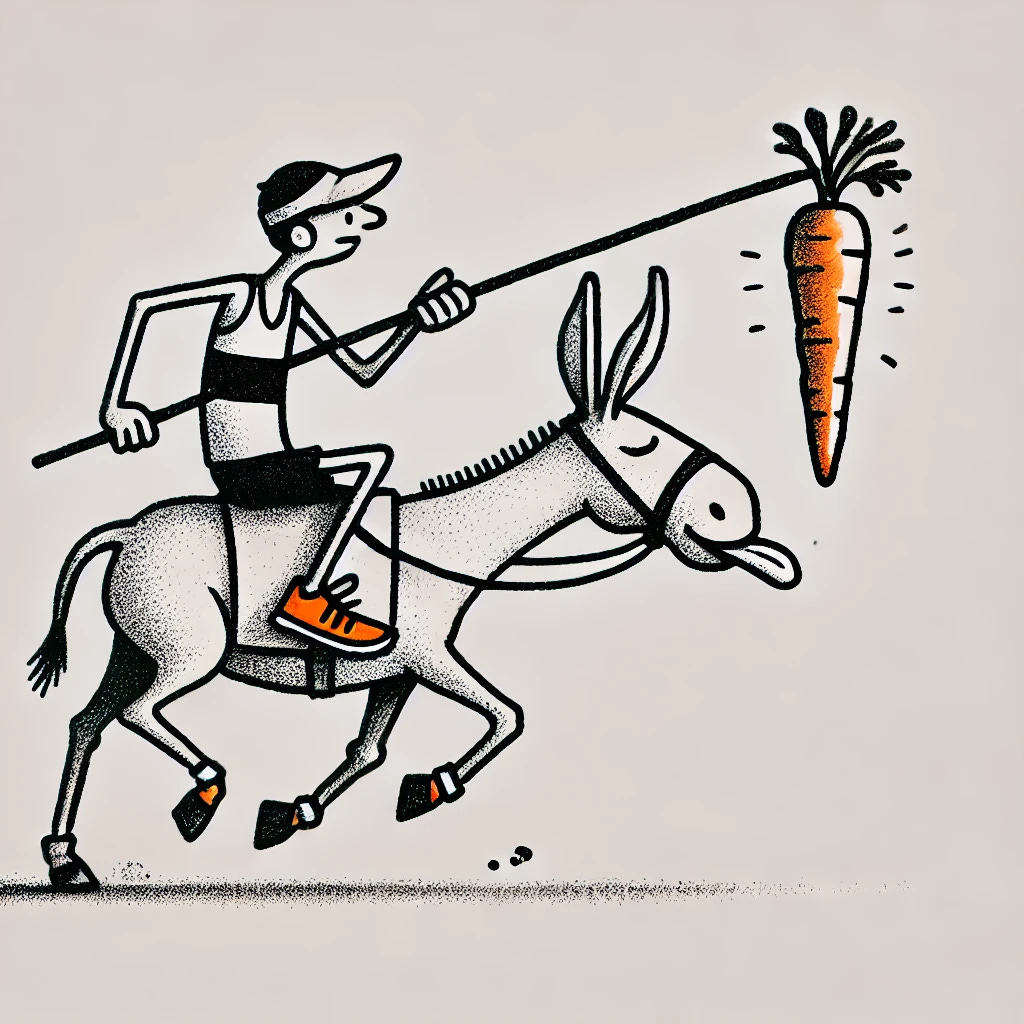
I always need something to chase. Like, donkey—stick—carrot is real AF. But unlike the donkey, I know I won’t get that carrot. The stick is the most valuable thing.
So, what if I could at least lick it a few times and find out how it tastes? I then find out that it’s pretty average tasting, like no-frills store-brand cookies; what if I kinda like that blah average taste? What if, instead of chasing, I focused on maintaining?
That feels new and, honestly, kinda exciting.
It’s funny; sometimes, chasing is just a way to hide. If I’m always chasing something big, something perfect, I can avoid just being in the moment—avoiding the everyday stuff that’s just good enough. But what if good enough is where it’s at? What if keeping up the day-to-day is more complicated than chasing perfection?
It sounds good now, but will I be bored in ten years? Will I get tired of it? Over the last six years, since I decided to chase a sub-16-minute 5k, I’ve hit overtraining, felt burnt out, and wondered— “wtf am I doing, I’m not pro. I want to say that I ran a 15:59.” Would anyone even care? Maybe some of you would be inspired to run faster, but this is my life, not yours, and I’m sure I’d get a lot of orange thumbs up on Strava that would have the lasting gratification of eating Skittles.
Trying to keep my fitness up for as long as possible feels way more challenging and maybe more interesting.
The inevitable slowdown of age? Yeah, it’s going to happen. But what if the experts are right? What if you only lose it when you stop using it?
Maybe the real challenge isn’t getting a new best time every year but showing up every day and staying consistent. It’s not flashy, but maybe it’s real.
So, I’m switching things up. Instead of chasing a sub-16-minute 5k, I aim to run as fast as possible for as long as possible. That should be around 17 minutes. It’s not as perfect as breaking an even time, and it sounds a bit clunky, but that excites me. I also might change my mind later and go after that sub-16 again… but right now? Nope.
And here’s three reasons why:
If I put everything together and throw the kitchen sink at it, I think I could get close to 15:59, but is it worth it?
I’ve already gone too hard chasing the sub 16 min 5k goal and ended up with overtraining syndrome back in 2022
I don’t want just to do the bare minimum, be mediocre and not ship/do something meaningful
Let me quickly dive into all three.
Help other runners get 1% better each day with this free newsletter and share it out! The is the best support you could give.
1. Sure, I can probably do the sub 16 min 5k, but at what cost?
I just completed twelve months without racing, and I didn’t die. In 9 weeks, I’ll race two races. As I do them, I feel my old obsessive perfectionist side creeping back.
I just spent three weeks in the U.S. with my 5-year-old, trying to keep my fitness up—and even improve it for my annual 1% better half marathon challenge. Yeah.. not smart, I know. I ended up lightly straining my achilles and running in ridiculous heat and humidity. I was low-key breaking myself down, chasing that all too familiar perfection.
Then, I flew back home and jumped back into training because my half-marathon was only ten days away. I pushed through one of the hardest workouts in the plan—jet lag and all— and I toast. I looked at myself in the mirror and said, “WTF are you doing, man?”
2. Overtraining Syndrome while chasing perfection
The last time I pushed too hard, I ended up with overtraining syndrome. It was not fun. I never really talked about it because I was a bit embarrassed and didn’t have the sports science background to explain it adequately and make it one of those “do as I say, not as I do” coaching moments.
Here is a quick recap of my experience with overtraining syndrome:
My sleep was trash — I constantly woke up in the middle of the night, and I was wired
Short, easy runs left me feeling wrecked like I’d been hit by a truck.
Fortunately, I recovered after only a couple of months— Some pros are laid up for a year or more.
Right now, chasing a fast(er) 5k isn’t on my radar. I’ve got other stuff going on, like growing this content brand, being present for my kid, and just slowing down to enjoy life more. Maybe I’m leaving some gains on the table, but nobody cares. Staying fit and healthy for the longrun (maybe, pun intended — lulz) beats burning out for a moment all day, any day.
And here’s the thing… I’m realizing it’s not about perfection anymore. It’s about showing up, doing the work, and shipping it when it’s good enough.
But with good enough, you can easily slip into mediocrity, right? Well, this dovetails nicely into my third point.
3. How I can avoid mediocrity
Mediocrity is a weird, subjective, messy thing. It’s the lower threshold of what you deem acceptable. What I think is acceptable could be one person’s highest standards and another person’s crap.
Unpopular opinion: I think most of society is quite soft. I know with a lot of evidence that it’s not hard to be better than most if you show up with curiosity, intention and consistency. Those three things are the background of successful people and companies worldwide.
Inspiration, hard work, passion, money, love, etc., are as long-lasting as a match. There is lots of fire, flame, and heat, nothing except cool, windy air, black smoke, and a weird smell that lingers for way longer than the match was lit.
Success lies in consistency, doing work, and letting the world see your work (aka shipping work). Most of the time, it means putting out unpolished work that was still well crafted and thoroughly worked through.
Creating lower limits to avoid mediocrity
Like almost everything in my obsessive-compulsive life, I have a framework and guardrails:
Keep training time to minimums and maximums: When I get into a flow out of perfection anxiety, I tend to go hard and do more things. But more time at something isn’t always better. I have to keep myself from overdoing it by having a lower threshold. The minimum won’t be hard to meet, but it’s still there.
Don’t stress about weekly totals. I’ve been doing this long enough to know that if I focus on the day-to-day, the week sorts itself out 99% of the time.
Set three goal races a year (I’m not 100% sure of this, but it sounds cute for now): a half marathon, 10k, and 5k to test my fitness. There is no specific training until eight weeks out. This way, I’m forced to keep a solid base all year and can do what I love doing best: training.
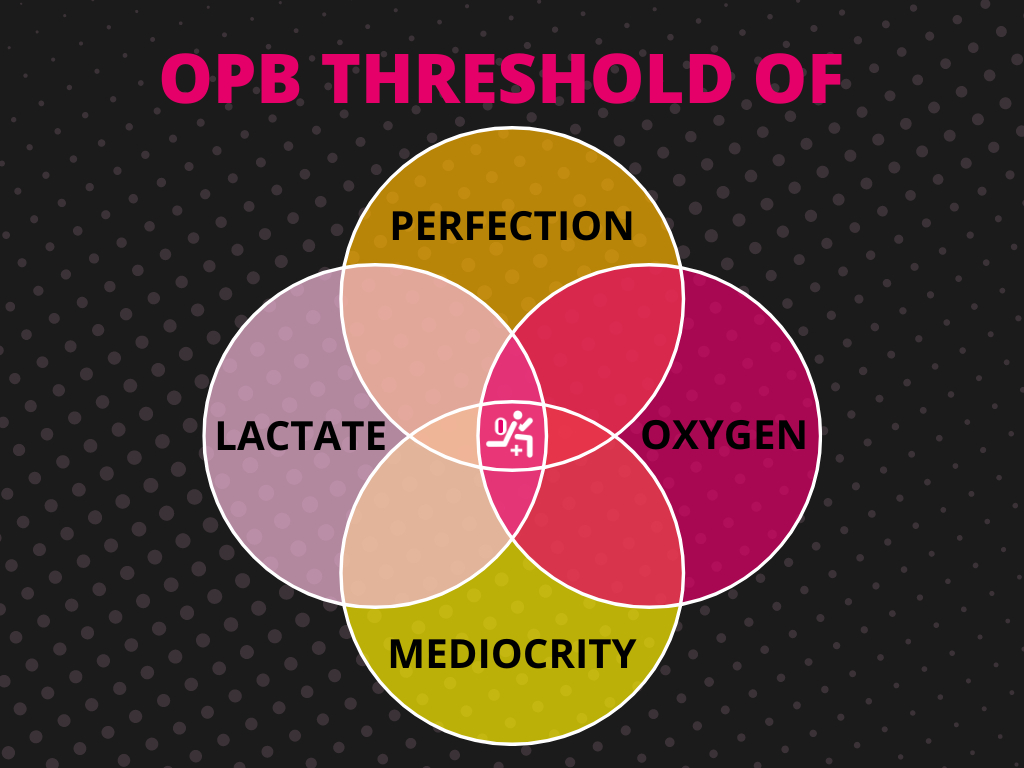
This plan is far from perfect, and it’ll probably change, which is the point — but for now, it feels kinda dope. Maybe that’s the sweet spot, like doing tempo runs at sub-lactate-threshold. It’s good enough to keep moving forward and using oxygen for as much energy as possible. Not building up too much lactate to cause that burning discomfort sensation, but not slow enough to where you’re embarrassed by your time at the end of the race. The threshold of perfectionism, mediocrity, lactate and oxygen
How Letting Go of Perfection Made Me a Faster Runner Watch, listen and read the full episode here [00:00:00] All right. Let me, let me tell you something like [00:00:01] just move, move a bit closer. [00:00:02] Trying to be perfect is ruining your progress. [00:00:06] I am super frustrated at missing workouts sometimes and eating the wrong thing. [00:00:10] but you know what? I sort myself out because most things, most of the time, if you do most of the stuff, most of the time it’s insurance for you to miss something for you to not have to worry about things. [00:00:21] And I’m not a perfect runner at the end of the day. Like I’ll be like completely honest. I’m not even close and I’m not pro, but I’d say I’m pretty fast. Know, sub three hour marathon or 10 hour Ironman finisher. I like to say that a lot trying to get my marathon time even faster as I age my half marathon time, 5k time, et cetera. [00:00:38] But. I don’t do the most efficient thing. I try not to even be optimized perfectly. I try to do what I like doing. I like to stay up late sometimes, not too late, but a little late. And I like to create all this content. I love this stuff. I like to create just general art and, you know, I might. Miss out on 15, 30 minutes of sleep every now and then I do eat junk food. [00:01:02] I love, love chicken wings and fries, uh, burgers. I do love those probably don’t eat too much, the 10 to 20 percent mark because cholesterol and all that, but I let it go. [00:01:11] I might crave it and then I give into it because if you’re not letting yourself have the things that you really want, you explode, you break [00:01:17] the best runners. Honestly, they’re not perfect. They are just consistent. Consistency is key. Everyone says it’s rah, rah, rah, rah. It compounds. It’s amazing. It’s a weird thing. It’s just like money in your bank account, in a savings account or an investment account. [00:01:30] Just compounds day on day, week on week, month on month, year on year, decade on decade. [00:01:35] And you have this fitness kind of savings account to pull from whenever you need it. If you get injured, if you don’t, you’re not able to run for a while, if you need to do a wacky race, you can just pull from that bank of fitness and it works. You just got to believe and trust that it actually works and be patient. [00:01:50] Belief, consistency, patience. Those are the three core pillars of the 1 percent better runner, [00:01:54] which I’ll talk about later on. [00:01:55] And honestly, chasing perfection will lead to burnout while consistency leads to re energizing yourself, wanting to come back the next day and long term success. [00:02:06] So you want to stop when you feel good at pretty much everything. I’d say 99. 9 percent of things in life. If you’re feeling good, just stop it. Like I love making this content stuff at night. I end up just stopping it. And just being like, you know what, I want to come back tomorrow and finish this. So i’m gonna stop halfway or you know, i’ve got this section done. [00:02:23] I’m done I don’t need to go anymore and the same with running like I felt really good last week running a bunch And I hit you know, one of my biggest volume wise weeks. It was 80 kilometers 50 miles in a while. And I was like, you know, Darren, how about you just take a chill recovery day on Monday, do some aqua jogging. [00:02:39] I didn’t need to go out there and run. It’s a recovery week. It’s already scheduled. I don’t need to do any more than I’m doing right now. [00:02:45] So remember he who keeps going wins and being successful and winning is very subjective to you, but you will win at your own game of life and health and fitness and just doing cool stuff and being able to have enough energy and ability to do this as you get older you want to perform better as you age 10 years ago self. [00:03:05] 10 years from now, [00:03:06] that’s at least my goal. [00:03:08] So nothing is anything without action. I’m going to give you some actionable task and advice to do right now, or at least in the next day or two, just drop your all or nothing. Perfection thinking, let it go. It’s unnecessary. [00:03:20] One bad day will not ruin your training. I promise. Think about it. If you like, Oh, I want to train six days a week and you end up training five days a week, two weeks in a row. [00:03:29] It’s not the end of the world. You’re going to be all right. Same with the weight room. Like this week, I’m quite tired and I have a lot going on in my family. And I’m like, you know what? I do have my weight room stuff I need to hit. I’m spreading it out across the whole week. So I’m going basically doing strength training. [00:03:41] I have some weights here that I make sure that was a reason for that to have weights in the house so that I can do workouts. I don’t have to go to the gym. I can do 30, 40 percent of my workouts here. I have them and I’ll just spread them out across. [00:03:52] I won’t be able to lift as heavy as I can in the gym, but that’s fine because most things, most of the time, I just want to show up, think longterm [00:03:59] zoom out. You have to zoom out when you’re working out. When you zoomed all the way in, you’re in the nitty gritty, the grind of everyday life. [00:04:05] It’s not a good place to be. You need to be in it sometimes, but most of the time you should be zooming out, making sure like, is this what I want to do? [00:04:10] Is this the end goal? And the small details don’t matter. You can’t even see them when you zoomed out. Earth just looks like a nice ball of blue and green and, you know, brown earth and whatnot. You don’t see the details of all the horrific stuff that’s happening on earth. Same. You won’t see the, the miss workouts. [00:04:25] When you zoom out, you’ll just see a line that goes straight up. [00:04:28] Hey everyone, quick heads up about magic mind, the tiny nootropic shot I’ve been testing out. It’s basically a brain booster that keeps me focused without making me feel wired or jittery. I’m always on the lookout for new ways to level up my running and my writing routine because I write a lot and create content in general. [00:04:45] So I try it for a few days and boom, 45 minutes of super focused writing. Yes, I’m not lying here. And even on a long run, I took it in the middle and at the end felt great. I felt steady energy. with no upset stomach. That’s probably the biggest thing. Wondering how smart supplements can help your endurance and mental clarity. [00:05:05] Well, Magic Minds got legit science behind it. Matcha, Lion’s Mane, Cordyceps mushrooms are part of my 17 race toolkits. It’s one of the things that’s part of war juice. They help with aerobic endurance and general aerobic speed. So amazing that they got that in there and a bunch of vitamins. Plus, if it’s not your thing. [00:05:22] They will refund you. Yes. Check out magic mind. com for free us shipping. When you subscribe, it’s a chill caffeine alternative to coffee that has worked amazingly for me. Use D lake D L A K E for 20 percent off magic mind productivity shots and 48 percent off a three month subscription at magic mind. [00:05:42] com forward slash D L A K E 20. Check the show notes or video description for more details. Let’s get back into the show. [00:05:50] And last thing, number three, actionable advice to you. Enjoy the process. Life is about living. Yes. Suffering is a part of it. Doing hard things. Soft people don’t do hard things is something that I truly believe in. I take the stairs. I live on the eighth floor. [00:06:03] I take the stairs as much as I can because it’s slightly hard. I think, you know, what is it hard life now? Easy life later, easy life now, hard life later, but enjoy the process [00:06:13] it’s kind of carrot stick. And then sometimes you need to just eat that carrot and the carrot needs to taste really good. [00:06:18] Or lollipop or ice cream, popsicle, whatever you want to eat, cake, whatever you want to eat. Just enjoy it, you know, [00:06:23] go out for that dinner if you do that or go on that vacation holiday if you want or you know buy that thing or Eat that thing or stay up late do whatever you want every now and then that’s fine I’d say if you could do it 10 20 percent of the time it’s absolutely fine [00:06:35] and another thing is enjoy running Even though running can be suffering make it so that running is fun some of the time 30, 40 percent of the time. [00:06:43] I mean, for me, it’s fun most of the time, but you know, maybe for you running is a different tool in your tool set in your toolbox that you need to do X, Y, Z, but make it enjoyable so that you can again, keep doing it and you can keep showing up and you can be consistent. So I’m going to end it here. With a couple of kind of trite, but true quotes, you don’t need to be perfect. [00:07:04] You just need to be consistent. That’s, that’s all it is. Like, again, most things for the third time, most things, most of the time [00:07:10] embrace being not perfect and just show up for the sake of ticking the box and showing up focus on the input. [00:07:17] Let me know what you’re doing to help you show up every day consistently in your running life below in the comments or email me talk at D lake creates. com. If you’re listening on the podcast, I again, and Darren D Lake, a sub three hour marathon, a 10 hour Ironman finisher, [00:07:31] this is the 1 percent better runner [00:07:32] where our goal is to help you with small daily step by step incremental improvements, get 1 percent better each day, each week, each month, compound it all. So that you can crush your running life and you can look back, you know, a year from now, two years from now, three years from now and go, look, I stuck with it. [00:07:49] I did the boring work. [00:07:50] I did the really monotonous work, but I enjoyed it. I enjoyed the process and look what I have now. That’s the goal. [00:07:56] We try not to do the hacky stuff. [00:07:57] We try not to do the inspirational motivational quotes because that doesn’t last you. That’s not the longstanding energy slow burn that you need to crush everything. [00:08:07] So I’m going to leave it there. Thanks for rocking with me. Peace.

 Running Nutrition Isn’t Hard. It’s Misunderstood. (Nutrition Masterclass)
 Your Foam Roller Isn’t Working. Use It Anyway.
 If You Can’t Do This Speed Workout, You’re Not as Fit as You Think
 The Dangerous Level of Strava Runners No One Talks About
 You’re Doing 10K Training Wrong, And It’s Keeping You Stuck