
Audio
Video

I proved every fitness guru wrong—and gained 8 pounds (4kg) of muscle while training and running almost every single day.
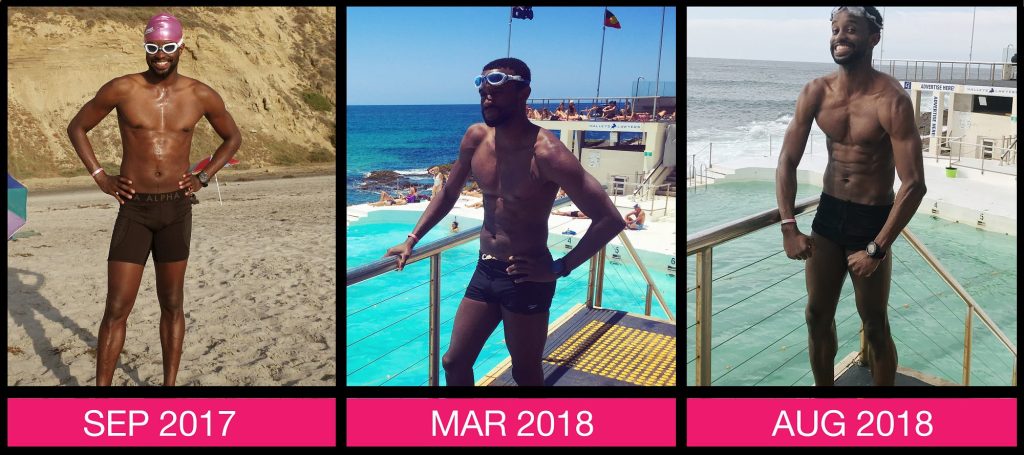
Four months. Built muscle. Lost 17 pounds (8kg) of fat.
No bulk. No cut. Just innovative, boring, consistent training.
Here’s the exact system that made it work so you can do it for yourself.
What You’ll Learn
So here’s what we are gonna do:
- I’ll break down the simple framework that lets me run and train most days
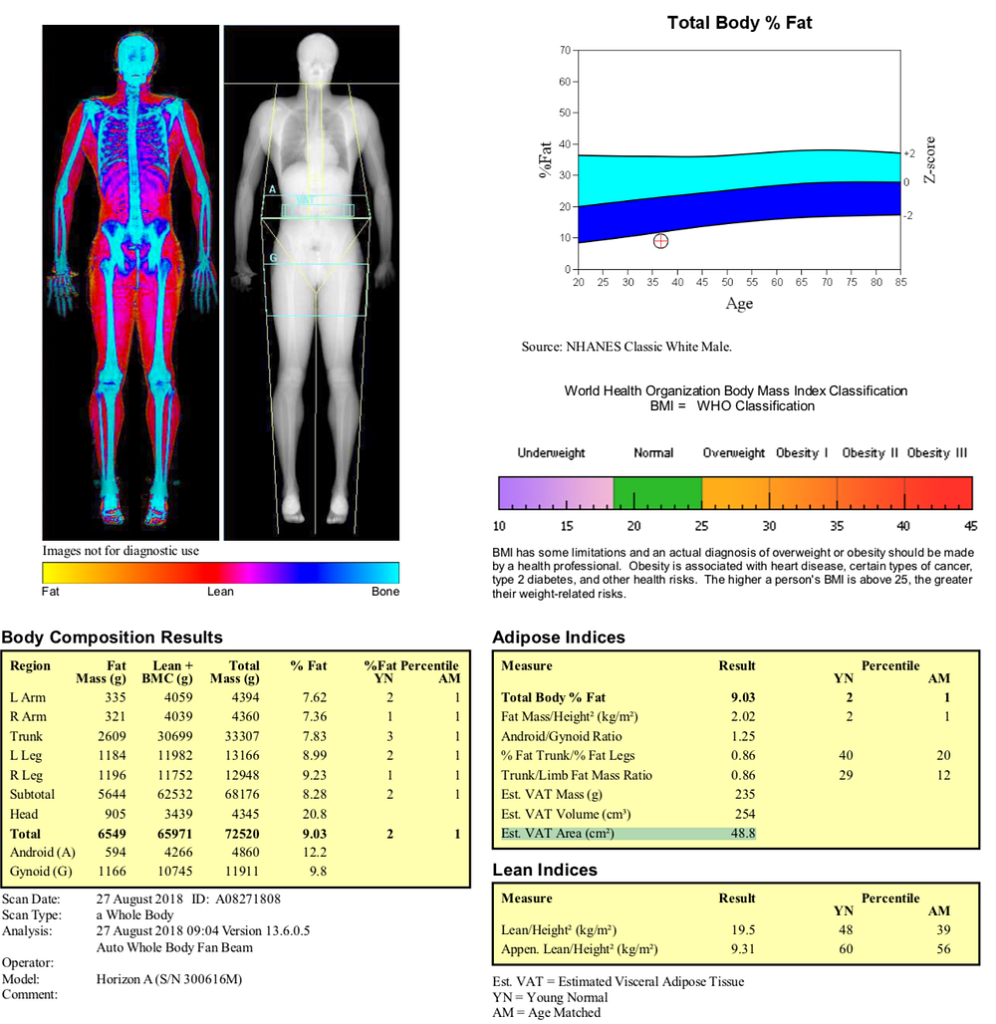
- Go through my real-world DEXA scan data on how I gained muscle
- I’ll walk you through my actual system and training week that you can take for yourself, aka a free training plan.
- The one mindset shift that actually made it stick
- And you’ll have the chance to help a fellow runner get 1% better – more on that shortly
Why I’m Obsessed With Strength Training
I’m Daren Dlake—run coach and endurance nerd of almost 30 years.
I’ve trained hard and recovered smart every day for 8 years straight – no silly running streaks. I just want to show 20,000 self-coached runners how to get 1% better each day and possibly gain some muscle while running a lot in the process.
But honestly, this started with frustration.
Significantly over weight and unhealthy, friends and family were trying to get in shape and falling off the wagon—again and again.
You know the yo-yo cycle… Get fit, get sick, holidays come around, lose momentum… repeat.
It felt like black magic. And I didn’t want to be another “yeah, I should probably get back into it” cliché.
I also didn’t want to be the fit and healthy-looking 50-year-old who could run sub-3-hour marathons and had a heart attack because of underlying issues that could have been addressed in his 30s.
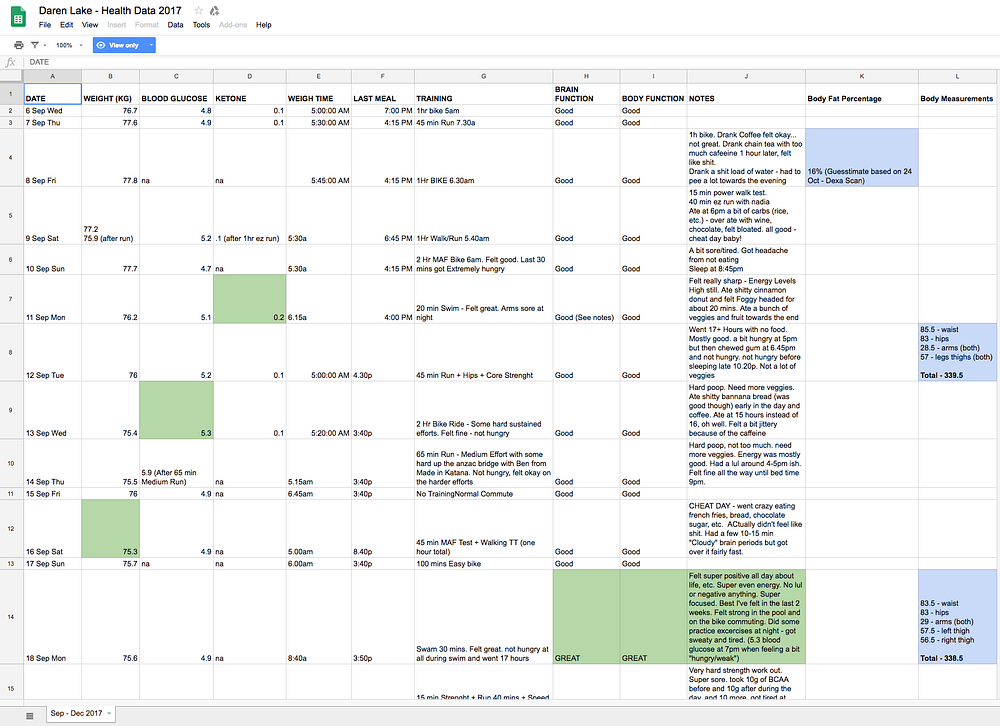
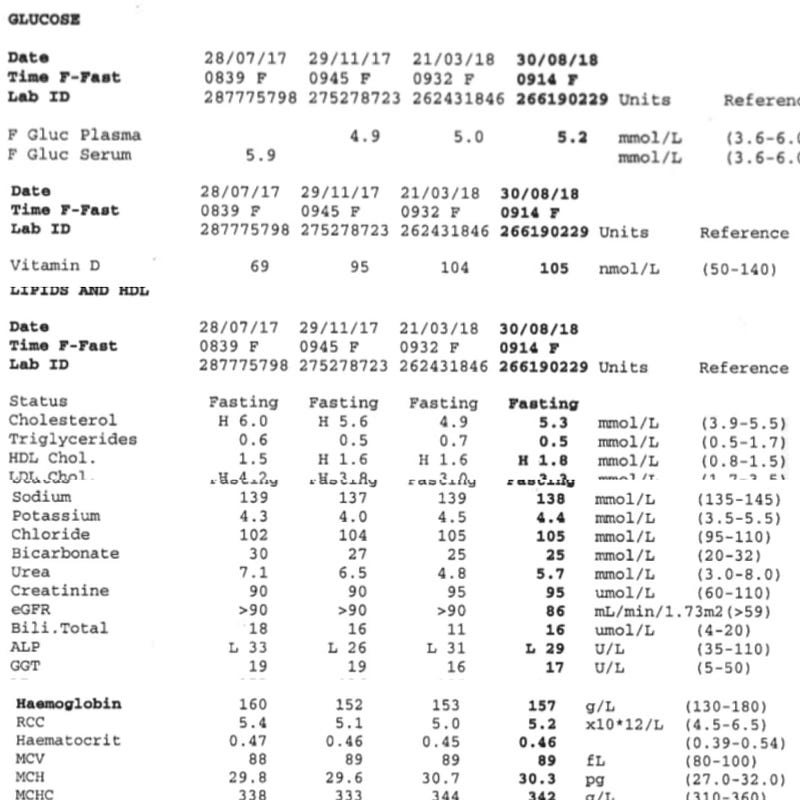
So I turned myself into a lab rat—tracked everything: body fat, blood sugar, VO2 max, food, sleep.
Was it the training volume? Or the food?
(Spoiler: it was both. But not the way I expected. more on that shortly)
And yeah—there was some vanity – I wanted that six pack from the magazines, and I had a terrible race that I wanted redemption on.
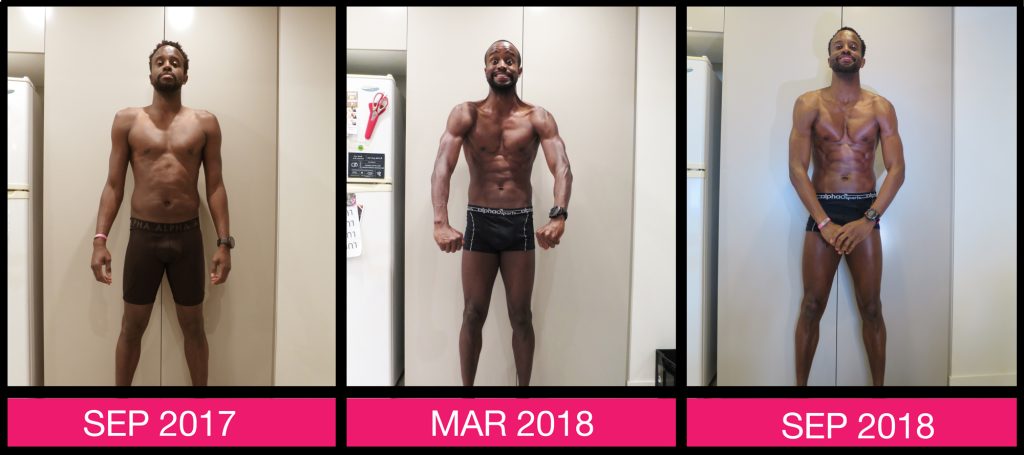
So after all of this, I trained smarter, leaned out to almost 8% body fat, and beat my time by 13%.
But the biggest shift? I stopped relying on motivation.
I built systems, processes and habits. Things I could fall off and hop right back onto like a freight train.
Toot toot, my friend.. toot toot 🚂
I’m just a running coach sharing what worked for me—consult experts for your specific situation.
How I Lost Body Fat & Gained Muscle

Back in 2017, post 10-hour ironman, I was fit-ish, being somewhat consistent in training, but way less (60% less), and I maintained eating the same calories, because I was still in the mindset that I could eat and drink whatever I wanted.
I didn’t want to bodybuild and power lift. I didn’t want to run ultra skinny either and get injured. I just wanted to feel… ripped and fast.
So I made a bet with myself — What if I could train almost every day—run, bike, swim, lift, drop body fat and still build muscle?!
Spoiler: I did. But only because I found one thing most people miss.
Not the workout —- Not the diet… The rhythm.
Here’s the quick cheat code formula:
(1) Strength train hard and heavy 2–3x per week,
(2) Time your runs and lifts smart (6+ hour split),
(3) The actual lifting protocol – super simple, make it work for yourself
(4) Eat enough protein and calories to recover,
(5) Recover like it’s part of your job.
Each of these elements works together like a finely tuned engine. You can’t have one without the other.
Now let’s break each one down so you can really understand it.
The Easy Day Advantage
The first part I call: the Easy Day Advantage, aka rhythm. Most people chase the high of hard days—intervals, long runs, gym PRs. But they don’t protect their easy days.
That’s where the magic happens.
Here’s the rule:
Your body needs 36-48 hours to recover from high-intensity stress and rebuild stronger fully. Stack hard days back-to-back and you’re just digging a hole instead of building fitness.
Strength training can count as a “hard day” if you are new to running or still figuring out things.
My rhythm? It’s this (I’ve been doing this a while, so it seems quite extreme, but you can do a modified version of this:
- Monday: Rest, super easy Recovery run/bike/swim/walk/hike (zone 1 at most) or Sauna
- Tuesday: Vo2 Max – short-ish intervals from 20 seconds up to 5 minutes at an 8-9 out of 10 effort.
- Wednesday: Strength Heavy & Explosive Power Moves or Hill Sprints/Plyometrics/Strides, this is just so that I can move things around
- Thursday: Tempo/Sub-Threshold work (zone 3)
- Friday: Strength Heavy & Explosive Power Moves or Hill Sprints/Plyometrics/Strides (hills/sprints/plyos/strides are never more than once per week)
- Saturday: Easy aerobic zone 1/zone 2 (run, swim, bike, walk, etc.) or Strength Heavy & Explosive Power Moves or Hill Sprints/Plyometrics/Strides if I missed a session that week
- Sunday: Long Run/race prep run (or ride/other cross-training activity if I’m in the off-season)
- Bonus: – during half/full marathon race season) Tue & Thu Afternoon: Easy aerobic zone 1/zone 2 (run, swim, bike, walk, etc.)
It’s not about doing less. It’s about layering. Hard, easy, medium. Repeat.
Use This To Gain Muscle & Run Your Best Times
I’ve got a free training plan that shows you exactly how to structure your week for maximum results without burning out.
It’s got a template framework that you can copy, paste, and modify to suit you with 3, 4, and 5-day-a-week variations. This isn’t the end-all, and is just the start for you to figure out how to self-coach yourself to gain muscle and run your best time.
Get it here.
And remember earlier how I said that you could help another self-coached runner? Well… all you have to do is watch this until the end. This tells the algorithm gods that other runners should watch this
And if you want to like, subscribe, and share the link out, that would be dope too.
OR better yet – comment below if you actually strength train and run – and if not, why not!
Let’s get back into it.
The Science of Interference Training & The Weight Room

And this isn’t just feel-good advice backed by my experience alone—here’s some evidence to support all of these claims.
You may or may not have heard of the interference effect.
The idea that strength and endurance cancel each other out?
That’s not quite true.
What actually happens is your body runs on two main pathways – a bit of run science for a second – hang with me:
- mTOR = muscle building
- AMPK = endurance adaptation
Think of them like apps on your phone. Open both at once? They crash.
But open one, close it, then open the other? Smooth.
A 2012 study (link here) (Wilson et al.) found this:
When you split your lifting and running by 6+ hours? You get the same muscle gains as lifters who didn’t run at all.
It’s not interference. It’s just bad timing.
So yeah… It’s not about doing less. It’s about doing what’s right.
But what about the actual program that lets you lift effectively while maintaining your running? Let’s break down exactly what I do in the gym.
The Actual Lifting Plan for Runners to Gain Weight
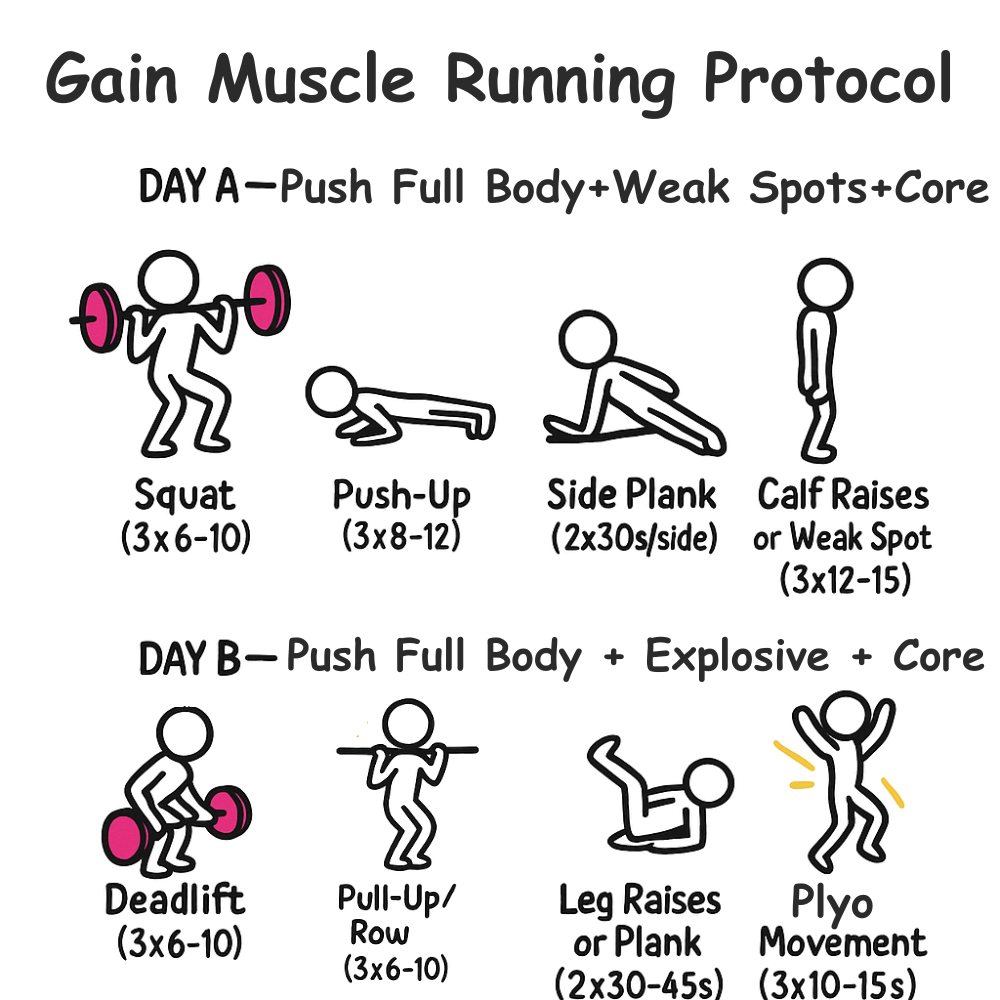
If I only had 30–40 minutes twice a week to lift (Because us runners barely have to run, let alone lift), here’s exactly what I’d do.
I like to have push and pull days – my ADHD brain likes the organization and focus
Day A (Push Day):
- Lower body Push – which can be Squat (Barbell, Goblet, or Dumbbell)
- upper body push — Push-Up or Bench Press
- Main Core – Holding yourself up with Leg raises, crunches, spoons, or front planks
- Run specific insurance – Calf Raises (or your personal injury-prevention move)
Day B (Pull Day):
- Lower body pull Deadlift (Trap bar, RDL, or Kettlebell)
- Upper body Pull – which can be Pull-Up or Bent Over Row
- Lateral or Side Core: Lying down leg raises with bands or side planks
- Explosive run-like movement/plyometric — Jump Variation (pogos, bounds, lunge jumps, etc.)
If you’re short on time, just hit the first two moves each day. Everything else is a bonus.
And if you’re a total beginner, start with bodyweight versions for a few weeks to get your form right.
[In card video – 5 strength training exercises]
The main thing is to lift with intention. Don’t waffle. Don’t scroll.
I’m in, focused, done in 35 minutes—with a mild sweat, endorphins flowing, and a little pump.
No fluff. No HIIT.
I lift around 80–90% effort and stop 1–2 reps before failure.
That’s where the gains happen without wrecking your energy for running. Going to full failure all the time is how you burn out.
And yeah, like running, progressive overload still matters. You’ve got to nudge it up over time—more reps, more weight, more range, more control. Doesn’t matter how; just do a little more than last week.
Think of it as a power-pair. I’ll squat heavy, then do an upper body movement like rows while my legs rest. That way, I’m still focused and not just scrolling, but I’m not turning it into HIIT either.
These movements hit the exact muscle imbalances runners develop—weak glutes, tight hips, underdeveloped upper body—while building the power transfer that makes you faster
Sometimes I add more/do variations of things, and sometimes I only have time to do the basics. In 1% Better running habits fashion, consistency is not perfection, and it can be a little bit or a lot over time, but it’s always something (even a rest day is considered doing something when it’s needed or scheduled in)
Variations & Regressions:
Bodyweight: If you’ve never lifted before, I highly suggest you start with bodyweight movements to master them, avoid injury, and get the most out of them later when you add weight. But… you will advance quickly beyond bodyweight after a few weeks.
You’ll get stronger, and even build some muscle—especially if you’re new. But eventually, you’ll need resistance to keep progressing. You can do this by adding resistance. That’s usually in the form of dumbbells, barbells, kettlebells, or machines (my least fav but a useful tool in certain situations)
Progressing it:
I would do either: a bit more weight each week, more reps, more sets, or a combination of all three at different times.
Example – Add 2.5-5 lbs (or kilos) per week for the lower body, 1-2.5 lbs (or kilos) for the upper body. When you can’t add weight, add 1-2 reps instead. If you can’t add weight or reps, add another set. Reset and repeat
As this is already getting long, I will go more in-depth in a future episode about the exact exercises I used and still use that magically keep working. Some days I don’t even feel like I did anything, and my body looks average, but my yearly DEXA scan proves that it’s working.
And if timing, sequencing, and the right gym plan are the keys to balancing strength and cardio, what about the fuel that powers it all? Could proper nutrition actually help minimize the interference effect by keeping your glycogen stores topped off?

Food & Nutrition
While I did an accidental extreme weight cut back 7 years ago not knowing what I was doing (crazy caloric deficit that wasn’t sustainable in teh long term), then had an exercise scientist and nutrionist at the dexa scan tell me to eat more + lift more I figured out how to gain musce.
But after doing that crazy cut and bulk phase where i almost got down to 8% body fat – I have not really had the need to split it like that. I just stay at maintenance and keep my muscle and fat where it is so I can run at the most optimal level.
I ate around maintenance, sometimes just over. Enough to train, feel good enough, not be hungry but also not be full, and get pudgy around the stomach and neck.
For most runners, eating at maintenance is roughly 15-16 calories per pound of body weight—enough to fuel your training without excess storage.
If you’re new to nutrition and running, check out this episode on nutrition pre and post meals that I did here or below in video description/link in show notes.
But quick TLDR:
Protein? Most science agrees that most humans need a lot of protein, and in particular, endurance athletes who burn crazy calories and gain muscle, gym rats. So if you want to build muscle, stay on the higher side at 1.5 – 2g per kilo (or .7-1g per pound) of body weight. You can get your protein however you want, but the best is real animal protein, beans, nuts, seeds, and powders. A mixture of many types is best if you’re plant-based. Timing is best after strenuous workouts (20-40 grams), and the rest is best just to do it across the day, consistently most days.
Carbs? If I’m in the off-season, I would do low to medium carbs and time it around workouts/hard days/strength training – they are very necessary for running – so don’t skimp like a non-runner/someone that sits around all day does.
Fat – Olive oil primarily for flavouring and whatever comes with my meats, nuts, beans bean-based protein. I don’t stress about this, but I try not to be in straight ketosis/eat junk foods/take away fast foods (high in not-so-great fatty oils).
Micronutrients – veggies fruits, seeds, nuts, etc. have all the essential vitamins. fat carries these to make sure your body is running optimally or you can also get it from suppleemnts – real foods first, supplements second.
Don’t starve yourself to stay lean and don’t force-feed yourself to get strong.
Just eat like someone who wants to train again tomorrow – I promise if you zoom out over time it works. I didn’t feel like I was almost 8% body fat, but dexa scan said it and looking back at those photos, I was quite shredded.
Recovery, Rest & Sleep
Recovery is where your body cashes the checks your workouts wrote. I like to break recovery into 2 parts: Rest & Sleep.
First up is rest. Rest isn’t inactivity—it’s strategic recovery. Sometimes that means a gentle walk instead of a tempo run. Sometimes it means a chilled out walk or even a sauna session.
And there’s the other side of revery: Sleep. It isn’t just a “nice to have.” It’s the entire foundation. You can’t out-train, out-supplement, or out-caffeine your way around bad sleep.
And here’s a bonus tip to know if you if you need coffee before 10:30 a.m. to feel human, you’re probably not sleeping enough. You’re surviving, not thriving.
You don’t need a Theragun. You don’t need another recovery supplement.
You need a bedtime—and the discipline to protect it like your bank account and those long runs that you love.
Remember: The goal isn’t to bulk, cut, or burn out.
It’s to train hard, recover smart, and build a body and mind that gets 1% better each day for as long as possibl

Use This To Run Farther and Longer
So if you haven’t already, go and get that free training plan that shows you exactly how to structure your training weeks between strength, running, cross-training, recovery, and nutrition.
And while you’re there, you’ll sign up automatically for my 5 mins or less email newsletter that goes deep on other topics to make you a 1% better runner each week.
But… gaining muscle and running faster might be a bit advanced for you. If you want to know how to run farther and longer without getting tired check out the video below, link below or in your show notes.
Peace.
[Read more]
[00:00:00] : I proved every fitness guru wrong and
[00:00:02] : gained eight pounds, four kilograms of muscle while
[00:00:05] : training and running almost every single day.
[00:00:08] : Four months, built muscle lost, 17 pounds, eight kilograms of fat, no bulk, no cut.
[00:00:15] : Just smart, boring, consistent training.
[00:00:17] : And here’s the exact system that made it work so you can do it for yourself.
Section: What I’ll Be Going Over
[00:00:22] : So here’s what we’re gonna do. I’m gonna break down the simple frameworks and systems that I use to let me run and train most days I’ll go through my real world DEXA scan data and show you how I lost fat and gain muscle. I’ll walk you through my actual system and training week that you can take for yourself a KAA free training plan.
[00:00:37] : Download the one mindset shift that actually made it stick, and you’ll have the chance to help a fellow runner get 1% better. More than that shortly.
USP
[00:00:45] : I’m Daren D Lake run coach and endurance nerd of almost 30 years. I’ve trained hard and recovered smart every day for eight years straight. No silly running streaks. I just want to show 20,000 self coach runners how to get 1% better each day and possibly [00:01:00] maybe gain some muscle while running a whole bunch in the process.
[00:01:03] : But I’ll be honest, this started with frustration. I saw extremely overweight and unhealthy. Friends and family we’re trying to get in shape and we’re falling off the wagon again and again.
[00:01:12] : You know that yo-yo cycle, you get fit, you get sick, holidays come around, lose momentum, repeat. It felt like black magic, like how do you actually lose weight? How do you gain muscle? And I didn’t want to be another, yeah, I should probably get back into it. Cliche. I also didn’t want to be the fit and healthy looking 50-year-old that could run sub three hour marathons and have a heart attack because underlying issues that could have been addressed back in my thirties.
[00:01:34] : So I turned myself into a lab rat tracked everything, body fat, blood sugar, VO2 max food, sleep, et cetera. Was it the training volume or the food spoiler? It was both, but not the way I expected. And again, more on that shortly. And yet there was some vanity.
[00:01:47] : I wanted that six pack from the magazines and I had a terrible race that I wanted redemption on. So after all this, I trained smarter, leaned out to almost 8% body fat, and I beat that time from that race that I wanted redemption [00:02:00] on by 13%.
[00:02:01] : But the biggest shift, I stopped relying on motivation. I built systems, processes, habits, you know, things I could fall off and hop right back on, like a freight train.
[00:02:11] : Two. Two, my friend, two toot. Huge warning. I’m just a running coach chair. What worked for me? Consult experts for your specific situation when it comes to weight loss, et cetera.
Section: How I Lost Body Fat & Gained Muscle
[00:02:19] : So back in 2017, post 10 Hour Ironman that I did, I was fit ish being somewhat consistent in training, but way less training, 60% less overall. And I maintained eating the same calories because I was still in the mindset that I could eat and drink whatever I wanted. I was like mid, early thirties. I didn’t want to be body build, like cut, and I didn’t want to power lift. I didn’t wanna run in an ultra skinny type body either and get injured. I just wanted to feel.
[00:02:44] : Kind of ripped and kind of fast. So I made a bet with myself. What if I could train almost every day, run, swim, bike lift, drop body fat, and still build muscle? ’cause I heard it was really hard. Spoiler, I did, but only because I found one thing that people miss. [00:03:00] Not the workout, not the diet. Those are important, but it was the rhythm.
[00:03:04] Here’s the quick cheat sheet Formula one strength train hard and heavy two to three times per week. Two time runs and live smart. Six plus hour split between. So one early in the morning, one in the afternoon, or evening. Three, the actual lifting protocol. Super simple. Make it work for yourself. So I just give you the framework and you can adapt it for your own life.
[00:03:26] Four, eat enough protein and calories overall to recover, and five, recover it like it’s part of your job. Each of these elements works together like a finely tuned engine. You can’t have one without the other. Now let’s break down each one so you can really understand how this works.
Section: The Easy Day Advantage
[00:03:42] : The first part I call the easy day advantage. AKA rhythm. Most people chase the high of hard days intervals, long runs, gym personal best, but they don’t protect their easy days. That’s where the magic happens. Here’s the rule. Your body needs 36 to 48 hours to recover from high intensity stress and rebuild [00:04:00] stronger, stack hard days back to back, and you’re just digging a hole instead of building. Fitness. Strength training can count as hard days if you’re new to running or still figuring things out. But for me, I’m not saying I’m a special snowflake, but I know a lot of advanced runners and experienced runners that also have been in the gym a lot.
[00:04:16] : You can make your gym days. More on the easy and moderate, but that’s more advanced stuff. So my rhythm, it’s been this, I’ve been doing this a while. So while this seems a bit extreme, you’ll see my weekly schedule, uh, you can do a modified version of this and I’ll actually have a modified version for you very shortly.
[00:04:32] : So Mondays rest, super easy. Recover, run, bike, swim, walk, hike, zone one at most. And or sauna. I like to do the sauna. I’m fortunate I got a sauna next to me, like really close to me. Tuesday is usually my VO two max days. So these are short-ish intervals ranging from 20 seconds up to five minutes with a very long rest. So usually longer than the interval or half. If they get up to the five minutes, I’ll do about three minutes rest and I like to do those at a eight to nine out of 10 [00:05:00] effort Wednesday, strength heavy plus explosive power moves or hill sprints slash plyometric slash strides.
[00:05:06] : I have all of these in there. I don’t do all of them in the same day. Usually I just have them there and I try to move it around ’cause you’ll see how Wednesday and Friday are mirrors of each other. Thursday tempo sub threshold work. So high zone two, low zone three type of stuff.
[00:05:20] : Mid zone three Friday. Again, similar to Wednesday. Strength, heavy explosive power moves or hill sprints, plyometric strides. The hill sprints, uh, and the regular flatland sprints, p PIOs, and strides are never more than once a week. So I don’t do all of that both days. It’s just wherever I can move things around. Saturday is easy. Aerobic zone one, zone two. Uh, I like to do either run, swim, bike, walk, whatever, aqua jog or strength, heavy and explosive power moves, or again, the hill sprints, plyometric strides if I miss them between Wednesday and Friday because.
[00:05:50] : Life happens. So I always bake in insurance to account for life happening. I got a 6-year-old kid, got a partner, so many variables. And then Sunday is usually my long [00:06:00] run race prep run, or if I’m in the off season, I’ll do a long bike ride or cross training activity just because I’ll have some fun.
[00:06:08] : I might ruck for two hours, go for a really long hike or something bonus during the half slash full marathon race season, which try to only do once or twice a year. Uh, the Tuesday and Thursday afternoons. Become an easy aerobic zone one, zone two, so I can get more base build up that aerobic system because that really helps the half in full marathon and just is more insurance for injury protection.
[00:06:30] : And it’s not about doing less, it’s about layering hard, easy, medium, repeat.
[00:06:35] So now that you understand the rhythm behind combining strength and running effectively, you’re probably wondering how can I actually implement this into my own training?
Section Ad Break – Use This To Gain Muscle & Run Your Best Times
[00:06:43] : I’ve got a free training plan that shows you exactly how to structure your week for maximum results without burning out. It’s got a templated framework that you can copy, paste, and remix and modify to suit your own needs and your own schedule with three, four, and five day a week variations.
[00:06:58] : This isn’t the end all, [00:07:00] it’s just the start for you to figure out how to self coach yourself to gain muscle and run your best time. And remember earlier how I said that you could help another self-coach runner? Well, all you have to do is watch this until the end. That’s it. This tells the algorithm guides that other runners, they should be watching this.
[00:07:14] : And if you want to, I would greatly appreciate it. You can hit the like thumbs up, subscribe and share, link out. That would be dope or better yet, comment below if you actually strength train and run. And if you don’t, why not? I love to hear it.
[00:07:27] : Let’s get back into it.
[00:07:28] —
Section:The Science of The Interference Effect
[00:07:28] : All right. Here’s a quick run science nerd. Break the science of interference training and the weight room.
[00:07:33] : So this isn’t just feel good advice backed by my experience alone. Here’s some evidence to support all these claims.
[00:07:39] : You may or may not have heard of the interference effect. It’s the idea that strength and endurance cancel each other out. That’s not quite true. What actually happens is your body runs on two main pathways. So we’re gonna get into the weeds of some run science for a second. So hang with me. There’s mTOR pathways and receptors. That’s muscle building, and there’s the A MPK receptors and pathways, and that’s endurance [00:08:00] adaptation. So think of them like apps on your phone open both at once and your whole phone crashes and you gotta reset it.
[00:08:05] : But open one, close it, and then open the other. Nice and smooth have some time. In between a 2012 study. Wilson Etal found this when you split your lifting and running by six plus hours. So again, you put it in the morning, you put it in the afternoon. You try to have some time between or even the next day, you get the same muscle gains as lifters who didn’t run at all.
[00:08:24] : It’s not interference really. It’s just bad timing. It is called the interference effect though, so, yeah, again, it’s not about doing less, it’s about doing what’s right
[00:08:32] But what about the actual program that lets you lift effectively while maintaining your running? Let’s break down exactly what I do in the gym.
[00:08:39] So if only add 30 to 40 minutes twice a week to lift. Because as runners, we barely have enough time to run, let alone adding, lifting. Here’s exactly what I do for each movement. Do two to three sets, eight to 12 reps. If doing two sets, five to eight reps, if doing three sets. Choose a weight where you could squeeze out one to two more reps, but stop there.
[00:08:59] [00:09:00] Prioritize good form while you get your exact ranges. This is for safety and also muscle gain. And for rest, you wanna do 90 to 120 seconds between sets. Enough to recover, not enough to lose focus. I like to have push and pull days. My A DHD brain, it just likes the organization and the focus.
[00:09:18] So day a or day one is lower body push, which could be any variation of a squat, barbell, goblet dumbbell. And then I like to do upper body push, which is bench press, usually any type of variation, bench press or a pushup. Then I like to focus on main core, so holding yourself up with the braces and doing leg raises, crunches, spoons, or front planks. And then I like to end it with run specific insurance if I have time. Calf raises for me personally and anything with hips, so the donkey kicks and the, uh, fire hydrants is what, uh, what I’ve started doing lately to strengthen my hips.
[00:09:56] But you may need personal injury prevention. Uh, for [00:10:00] yourself. So you might have weak hamstrings or weak glutes, then you need to do specific exercises for that. And then on day B or day two, I like to do a pull workout.
[00:10:07] This is where I’ll do deadlifts. So any type of deadlifts. R dls, trap bar is my favorite. Um, R DLS are Romanian deadlifts. The normal deadlift with the straight bar, kettlebell swing, single leg deadlifts, a lot of variations of it. Then an upper body pull, which can be a bent over row or the cable machine, the seated row or pull-ups,
[00:10:26] then I like to do lateral or side core, so that would be laying down leg raises, straight leg or bent knee, uh, with bands to help with resistance. Or just good old side planks and explosive run movements. Plyometrics, even explosive form drills. So Pogo bounds lunge jumps or Bulgarian split squat explosive jumps, those are a bit tough to do. So that’s quite advanced. If you’re short on time, just hit the first two moves each day. Everything else is a bonus. You get core with all of those movements ’cause you have to brace your core anyway.
[00:10:55] And if your total beginner, start with body weight versions for a few weeks to get your form [00:11:00] right. And I did a episode on the five best body weight exercises for runners. Go check that out up here. Or link below. The main thing is to lift with intention. Do not zone out, do not scroll. Go in there focused. Done. In 35 minutes, I get a mild sweat going, endorphins flowing, and a little bit of the pump. It looks nice. No fluff. I also don’t make it a hit workout. I don’t want to make this like, all right, I’m outta breath for 30 minutes.
[00:11:25] Like that’s not what we want, because I like to lift 80 to 90% effort.
[00:11:30] Stop one to two reps before failure. ’cause that’s where the gains happen. Without wrecking your energy system for running lots of science to back this up. So I like to do 80 to 90% like effort.
[00:11:41] It’s like, okay, I have a bit left in the tank and I stopped one to two reps before failure. Still get the gains, still get the muscle gains, still get the strength gains. There is science to back all of this up.
[00:11:51] That’s where the gains happen. Without wrecking your energy system for running, going to full failure all the time. You could do it every now and then, but going to full failure, we’ll burn you [00:12:00] out. We’re trying to save our energy for running. And yes, like running progressive overload still matters for lifting.
[00:12:05] Gotta nudge it up over time. More reps. Or you could do more weight or you could do more sets. It doesn’t matter how you do it, just a little more than last week. This again, has been documented with lots of science, lots of gym people have been tested on this. And obviously running is progressive overload a little more each week.
[00:12:23] But these movements back to the strength stuff. They hit the exact muscle imbalances. Runners develop weak hips, weak glutes, tight hips. Weak hamstrings, underdeveloped upper body while building the power transfer that makes you faster and you get to build some muscle with it and maybe look a bit better.
[00:12:39] Think of getting in the gym like power pairing. I’ll squat heavy, then do an upper body movement like rows while my legs rest. That way, I’m still focused and I’m not scrolling, but I’m not turning it into, again, a hiit workout. We don’t need to be out of breath and killing ourselves.
[00:12:54] This is to allow a TP to replenish in that muscle group. So you get yourself like three to five minutes between the [00:13:00] squat or the bench or the deadlift, et cetera, and these movements, they hit the exact muscle balances. Runners develop weak glutes. Tight hips, underdeveloped upper body while building the power transfer.
[00:13:11] That makes you faster with less energy and you might gain some muscle along the way and look kind of better in your run, singling or whatever you’re wearing. Sometimes I add more or do variations of things, and sometimes I only have time to do the basics. in 1% better.
[00:13:26] Running habits, fashion consistency is not perfection, and it can be a little bit or a lot over time, but it’s always something. Even a rest day is considered doing something when it’s needed or scheduled in. So some variations and regressions. Again, body weight if you never lifted it before, I highly suggest you start with body weight movements to master the link is below.
[00:13:44] Avoid injury and get the most out of it later when you add weight, but you will advance quickly beyond body weight after a few quick weeks.
[00:13:52] But enjoy, you know, if you’re doing body weight stuff, you’ll get stronger and even build to muscle, especially if you’re new. Because when you’re a beginner runner, you have that [00:14:00] learning curve going for you and just things are way easier in the beginning, but eventually, again, you might need resistance to keep progressing. You could do this by adding resistance that’s usually in the form of dumbbells, barbells.
[00:14:10] Kettlebells or machines. They’re my least favorite, but useful in certain situations. So I do use certain machines. Cables are really good, so not, it’s not really a machine. But the other machines, like if you wanna do a pushup machine, et cetera, that’s fine. If you’re learning, if you wanna learn the movements, if you don’t have anything else, that’s absolutely fine.
[00:14:28] So progressing it. I would do either a bit more weight each week, more reps, more sets, or a combination of all three at different times. Example, add two to five pounds or kilos. It’d probably be 1.25 to 2.5 kilos per week. For lower body and for upper body, you can do one to 2.5 pounds. If you can’t add weight or reps, add another set, reset and repeat
[00:14:51] as this is already getting quite long, I will go more in depth in a future episode about the exact exercises I used and still use that magically just keep working. Some days [00:15:00] I don’t even feel like I did anything and my body looks average, but my yearly DEXA scan. Proves that this is working and if timing, sequencing and the right gym plan is the key to balancing strength and cardio so you can gain muscle as a runner.
[00:15:13] : And if timing and sequencing is the key to balancing strength and cardio. What about the fuel that powers it all? Could proper nutrition actually help minimize that interference effect by keeping your glycogen stores topped up?
Section: Food & Nutrition
[00:15:23] : So let’s get into food and nutrition and how that can help you gain muscle while you run. And while I accidentally did an extreme weight cut back the seven, eight years ago, not knowing what I was really doing, I was in a crazy caloric deficit that was not sustainable in the long term and actually stops you from gaining muscle.
[00:15:39] : That’s a conversation for another day. Um, I had an exercise scientist and nutritionist at the DEXA scan tell me to eat more and lift more, and I figured out how to gain muscle. After doing that crazy cut and bulk phase where I almost got down to 8% body fat, I have not really had the need to split it like that. I just stay at maintenance and keep my muscle and fat where it needs to be so I can run at the most [00:16:00] optimal level, depending if I’m running five Ks, half marathons or marathons.
[00:16:03] : And I like to eat around maintenance, sometimes over, especially if I’m doing a lot of training. Enough to train, feel good enough, but not be hungry, and also not like crash in the middle of a run at the end of the day or something when I have a hard session. And I also don’t want to eat too much to where I feel full and pudgy around my stomach and my neck.
[00:16:21] : Uh, I did a whole episode on how to eat and Knock your fat. You can go check that out here, the link below in your show notes. But for most runners, , eating at maintenance is roughly 15 to 16 calories per pound of body weight. Enough to fuel your training without excess storage, or you can just go on a calculator online and type in kind of your activity. It’s called the BMR, not to be confused with BMI. It’s the basal metabolic rate and it shows you how much you need to maintain your macros, carbs, fat, protein.
[00:16:49] : Overall calories and then how much if you wanna lose weight, and then how much you want to gain weight. And then you put in your activity levels or you can get a DEXA scan, which is the most accurate. It’s a bit expensive, but you get those done once a year, [00:17:00] twice a year, whatever.
[00:17:00] : And if you’re new to nutrition and running, I’ve got another episode you could check out. It’s all about eating right, pre and post, run the meals that you need for that, and I did that up here.
[00:17:09] : You can go check that out or below in the video description or link in the show notes, but a quick TLDR on nutrition. In general protein. Most science agrees that most runners need a lot of protein, and in particular, endurance athletes who burn crazy calories. They do their long runs, they do their intervals, and if they’re in the gym, you need a lot of protein. So if you want to build muscle, stay on the higher side.
[00:17:28] : This is 1.5 to two grams per kilo. I’ll have the text up here, so if you’re listening, go to Spotify or YouTube and watch this, or on my website, you wanna watch this. Uh, but 1.5 to two grams per kilo. That’s for you Americans, that’s 0.7 to one gram per pound of body weight.
[00:17:45] : Uh, it’s confusing, but it’s not hard. So if you’re 150 pounds, you need 150 grams. If you’re 75 kilos, you need 150 grams. So it works out both ways. You can get your protein however you want, but best is real animal protein from science [00:18:00] and what I’ve read, uh, beans, nuts, seeds, and powders. You want a mixture of all of them. That’s best if you’re plant-based, obviously not animals. So you wanna get as many different types of plant-based protein as you can. So again, powders, beans, nuts, seeds, vegetables. Timing of the protein is best after a hard workout.
[00:18:17] : You wanna get in that window, that one to two hour window. 20 to 40 grams and the rest is best to just do it across the day. You could just spread it across the day consistently. Most days, most things, most of the time. That is actually gonna be a chapter in my upcoming book, the 1% Better Runner, so stay out on the lookout for that. I’ll be dropping that hopefully in the near future. I’m working on that. Carbs. So we got protein now we got carbs. If I’m in the off season, I would do low to medium carbs just ’cause I just don’t like that many carbs, in my body. And I just like eating satiated foods like protein and fats and seeds and nuts and dark chocolate.
[00:18:50] : But I like to time my carbs around. Workouts, hard days, strength training. They are very necessary for running. Do not skimp like non-runners or someone that sits around all day. They [00:19:00] can go low carb, they can go ketosis, they can go intermittent fasting. Please don’t do that. If you want to run a lot and gain muscle, you need the carbs.
[00:19:07] : It is literally the fuel that makes you gain weight. So fuel that keeps you going. And then last but definitely not least, is fats. So I like to use olive oil mainly for the flavoring and the, the moisture. So, you know, my chicken. Or my rice is not dry and I get whatever fats come with my meats, nuts, beans based protein.
[00:19:26] : I don’t stress about it. I’m not trying to really track fat too much, but I try not to be in straight ketosis eating junk food. I stay away from fast foods.
[00:19:33] : They’re high in fat in general, and saturated fats, which are not good. I have genetically high cholesterol that I need to work out, and saturated fats do not do very well for me. I need to make sure I stay away from them. Uh, also fast food takeaway is high in. Fatty oils and not high quality oils.
[00:19:48] : And then last but definitely not least, is micronutrients. You’ll get them with veggies and fruits and seeds and nuts. They’re high in that stuff. Teas have them. If you want to drink wine, I’m not a wine drinker. Wine has it, [00:20:00] and antioxidants grape juice chart, cherry juice. These are great places to get micronutrients, and the fat that you will take carries all these micronutrients to your blood and rest of the part of your body so you can run optimally and you can also get micronutrients from supplements, but I like to do real foods first and supplement second their insurance. Don’t starve yourself to stay lean and don’t force feed yourself to get strong. Just eat like someone who wants to train again tomorrow. I promise if you zoom out over time, give yourself weeks and months, uh, it will work. I didn’t feel like I was almost 8% body fat, but the DEXA scan said it.
[00:20:34] : And looking back at those photos, I was pretty shredded. And not to sound like kind of douchey and uh, humble brag, but I was quite shredded and you know, I have not gotten there because I realized that was the extreme and I know how to get there if I wanted to.
[00:20:47] : Was also seven years ago. And I’m like, you know what? That was fun. I got photos but probably will back it down and I could still run as fast. . The last part of gaining muscle so you can run a lot is recovery and sleep.
[00:20:56] : This is not the least, this is probably the most important.
Section: Recovery, Rest & Sleep
[00:20:59] : [00:21:00] Recovery is where your body cashes the checks that your workouts wrote. I like to break recovery into two parts. There’s rest and sleep. So first up rest. Rest isn’t inactivity. It’s strategic recovery. Sometimes that means un gentle walk instead of a tempo run. Sometimes it means a chilled out walk or even a sauna session.
[00:21:15] : And then there’s the other side of recovery. Sleep,
[00:21:17] : It isn’t just a nice to have, it’s the entire foundation. You can’t out-train or outs supplement or out caffeine your way around.
[00:21:23] : Bad sleep, not for long, at least. And here’s a bonus tip, if you know you need coffee before 10:30 AM to feel human, you’re probably not sleeping enough.
[00:21:30] : You’re surviving. You’re not thriving. You don’t need a theragun you don’t need another recovery supplement.
[00:21:35] : You need a bedtime and the discipline to protect it like your bank account and those long runs that you love. Remember, the goal isn’t to bulk cut or burn out.
[00:21:42] : It’s to train hard, recover smart, and build a body and mind that gets 1% better each day for as long as possible.
Section: Use This To Run Farther and Longer
[00:21:48] : So if you haven’t already, go and get that free training plan that shows you exactly how to structure your training. Weeks between strength. Running cross training, recovery, and nutrition, and while you’re there, you’ll sign up automagically [00:22:00] for my five minutes or less email newsletter that goes deep on other topics to make you a 1% better runner each week.
[00:22:06] : But gaining muscle and running faster might be a bit advanced for you. If you want to know how to just run farther and longer without getting tired, check out the video below or the link below in the show notes or video description peace
[/read]
Most Recent Articles
 Running Nutrition Isn’t Hard. It’s Misunderstood. (Nutrition Masterclass)
 Your Foam Roller Isn’t Working. Use It Anyway.
 If You Can’t Do This Speed Workout, You’re Not as Fit as You Think
 The Dangerous Level of Strava Runners No One Talks About
 You’re Doing 10K Training Wrong, And It’s Keeping You Stuck